

Introduction
If you want to trade like institutions, hedge funds, and professional traders, you must first understand market structure. Many retail traders focus solely on indicators, hoping that a moving average crossover or RSI indicators will reveal the next winning trade. However, smart money traders know that price action tells the real story.
Market structure is the language of the market. It reveals the direction to the trend, who is in control, where liquidity is resting, where institutions are likely to enter positions, and where price is likely to move next. Once you understand market structure, concepts such as order blocks, liquidity, break of structure (BOS), and points of interest (POI) become much easier to identify and trade.
In this guide, we’ll explore the core concepts used by Smart Money Concepts (SMC) traders and explain how mastering market structure can transform you into a more profitable trader.
What Is Market Structure?
Market structure refers to the pattern of highs and lows that price creates over time. It helps traders determine whether the market is:
- Bullish (uptrend)
- Bearish (downtrend)
- Consolidating (ranging)
By studying how price creates highs and lows, traders can identify the current direction of the market and align their trading decisions accordingly.
Think of market structure as the roadmap that shows where price has been and where it is likely to go next.
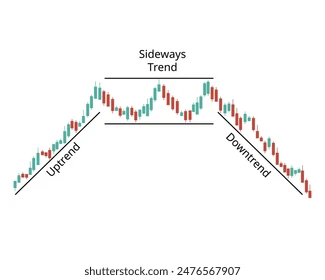
Understanding an Uptrend
An uptrend occurs when price makes:
- Higher Highs (HH)
- Higher Lows (HL)
This tells us that buyers are in control.
Uptrend Example
Characteristics of an Uptrend
✅ Buyers dominate sellers
✅ Demand exceeds supply
✅ Price continues making new highs
✅ Institutions are generally accumulating positions
Trading Approach
Smart money traders look for buying opportunities during pullbacks rather than chasing price at the highs.
The key question becomes:
“Where are institutions likely waiting to buy?”
This is where order blocks and points of interest become important.
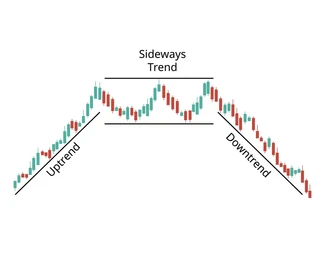
Understanding a Downtrend
A downtrend occurs when price makes:
- Lower Highs (LH)
- Lower Lows (LL)
This indicates sellers control the market.
Downtrend Example
Characteristics of a Downtrend
✅ Sellers dominate buyers
✅ Supply exceeds demand
✅ Price continuously creates lower lows
✅ Institutions are distributing positions
Trading Approach
In a bearish market, smart money traders focus primarily on selling from premium prices rather than buying dips.
What Is an Order Block?
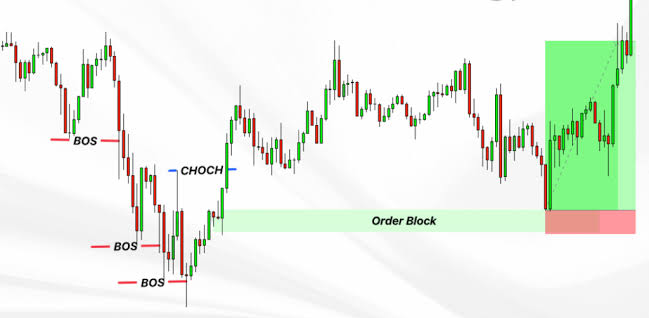
An Order Block (OB) is the last bullish candle before a strong bearish move, or the last bearish candle before a strong bullish move.
Smart money traders believe institutions place large orders within these zones. When price revisits the area, institutions often enter additional positions, causing a reaction.
Trading Logic
- Strong bullish move leaves behind an order block.
- Price retraces back.
- Market respects the zone.
- Buyers enter.
- Price continues upward
Visual Representation of a Bullish Order Block
What Is Break of Structure (BOS)?
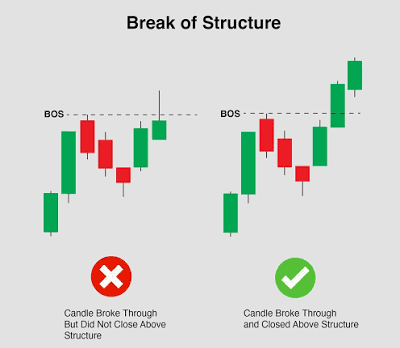
A Break of Structure (BOS) occurs when price successfully breaks a previous significant high or low.
It is one of the strongest confirmations that the market intends to continue in a particular direction.
Bullish exmple of a BOS
Exmple of a bearish BOS
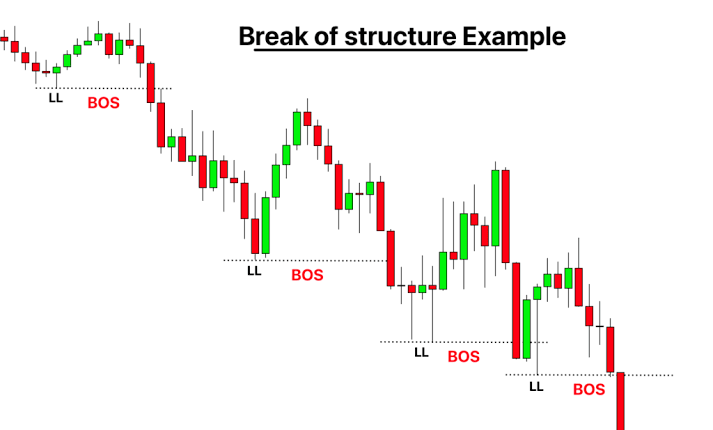
Why BOS Is Important
A break of structure confirms market direction.
Without BOS:
❌ Trend continuation is uncertain
With BOS:
✅ Trend continuation becomes more likely
Professional traders use BOS as confirmation before entering trades.
What Is a Point of Interest (POI)?
A Point of Interest (POI) is an area where smart money is likely active.
These zones attract institutional participation and offer potential trading opportunities.
Common POIs include:
- Order Blocks
- Fair Value Gaps (FVG)
- Supply Zones
- Demand Zones
- Liquidity Zones
What Is Liquidity?
Liquidity refers to the locations where a large concentration of stop-loss orders and pending orders exist.
Institutions need liquidity to enter or exit large positions.
Because of this, price often seeks liquidity before making a major move.
Common Mistakes Traders Make
1. Ignoring Market Structure
Many traders buy in a downtrend and sell in an uptrend.
Always align with structure.
2. Chasing Price
Entering after a large candle often leads to poor risk-to-reward ratios.
Wait for pullbacks into POIs.
3. Trading Against Liquidity
If a major liquidity pool exists above price, shorting becomes dangerous.
Market often moves toward liquidity first.
4. Using Tight Stop Losses
Smart money often sweeps liquidity before moving in the intended direction.
Placing stops directly above highs or below lows makes them easy targets.
How Understanding Market Structure Creates Profitable Traders
Market structure is not just a trading concept. It is the foundation of professional decision-making.
When traders understand market structure:
✅ They know the trend direction.
✅ They stop fighting institutional order flow.
✅ They identify high-probability entry locations.
✅ They understand where liquidity is resting.
✅ They use logical profit targets.
✅ They improve risk-to-reward ratios.
✅ They avoid emotional trading.
Most losing traders focus on predictions.
Profitable traders focus on probability.
Market structure shifts trading from guessing toward understanding how the market functions.
Instead of asking, “Will price go up or down?”
You begin asking:
- Where is liquidity?
- Who is trapped?
- Where are institutions likely positioned?
- Has structure shifted?
- What is my point of interest?
These questions help traders think like professionals instead of gamblers.
Conclusion
Market structure is the backbone of Smart Money Concepts trading. By understanding uptrends, downtrends, order blocks, break of structure, points of interest, and liquidity, traders gain insight into the behavior of institutional participants who move the market.
The most successful traders do not rely solely on indicators. They study price action, identify liquidity, wait for market structure confirmations, and execute trades from high-probability locations. External liquidity provides excellent entry and exit references, while order blocks and BOS help confirm institutional intent.
Mastering market structure will not make you profitable overnight, but it gives you a structured framework for analyzing the market objectively. Over time, this framework helps eliminate emotional decisions, improve risk management, and increase consistency. In trading, consistency is what separates profitable traders from the crowd. Understanding market structure is the first step toward joining that profitable minority.