

Gold remains one of the most actively traded commodities in the global financial markets. Over the past week, the precious metal experienced significant bearish pressure as a stronger U.S. dollar and elevated Treasury yields continued to weigh on prices.
On September 27, gold opened at $4,260.44 and closed at $4,230.96. This decline resulted in a clear break of market structure on the hourly timeframe, supported by a strong bearish candle. The breakdown triggered continued selling pressure throughout the week and reinforced the prevailing downtrend.
For Smart Money Concept (SMC) traders, this bearish move has created a high-probability market environment. Furthermore, the current price action suggests that gold may be forming another attractive bearish setup for the coming week, presenting potential opportunities for traders looking to align with the dominant market trend.
Before considering any trading opportunities on gold, it is important to understand the key fundamental factors currently influencing the market.
Fundamental
Market participants are increasingly focused on the Federal Reserve’s next policy decisions. Current expectations indicate approximately a 22% probability of a rate hike in October and an 84% probability in December. The Federal Reserve finds itself in a difficult position as it attempts to balance inflation control with mounting economic and debt-related concerns.
Long-term Treasury yields have climbed to levels not seen since 2007, increasing borrowing costs across the economy. If yields continue to rise, economic growth could slow further while debt-servicing costs increase substantially for both businesses and governments.
With the United States carrying nearly $40 trillion in debt, elevated interest rates place additional pressure on the financial system. However, maintaining rates at current levels or cutting rates comes with its own set of challenges. Lower interest rates could accelerate inflation expectations, potentially forcing the Federal Reserve back into a more aggressive tightening cycle.
This creates a difficult economic cycle:
- Higher interest rates lead to higher bond yields.
- Higher yields reduce liquidity and slow economic growth.
- Slower growth increases the burden of servicing debt.
- Lower interest rates may reignite inflation.
- Rising inflation could force further policy tightening.
In essence, the Federal Reserve appears trapped between two major challenges: inflation and debt sustainability.
As liquidity remains available, markets may continue to overlook these risks. However, if long-term yields continue rising while economic growth weakens, pressure could spread across major asset classes. Under such conditions, equities could face significant downside risk, bonds may remain under pressure, and precious metals such as gold and silver could experience heightened volatility. Risk assets, including cryptocurrencies, may be particularly vulnerable if liquidity conditions deteriorate further.
History has shown that during periods of financial stress, investors often sell assets based not on preference, but on necessity. This forced liquidation environment can create chain reactions that impact multiple markets simultaneously.
The market cycle can be summarized as:
Higher Yields → Tighter Liquidity → Falling Risk Assets → Forced Selling
Ultimately, the Federal Reserve may be forced to choose between controlling inflation and protecting debt markets. Regardless of the path taken, each decision carries significant consequences for financial markets.
This is the broader macroeconomic backdrop that many traders may be underestimating.
Technical Analysis
From a technical perspective, gold recently broke market structure on the 1-hour timeframe, confirming the continuation of the prevailing downtrend.
According to Smart Money Concepts (SMC), once a Break of Structure (BOS) occurs, traders focus on identifying the order block responsible for initiating the move. This order block becomes a key point of interest for potential future entries.
The current market structure presents several important elements:
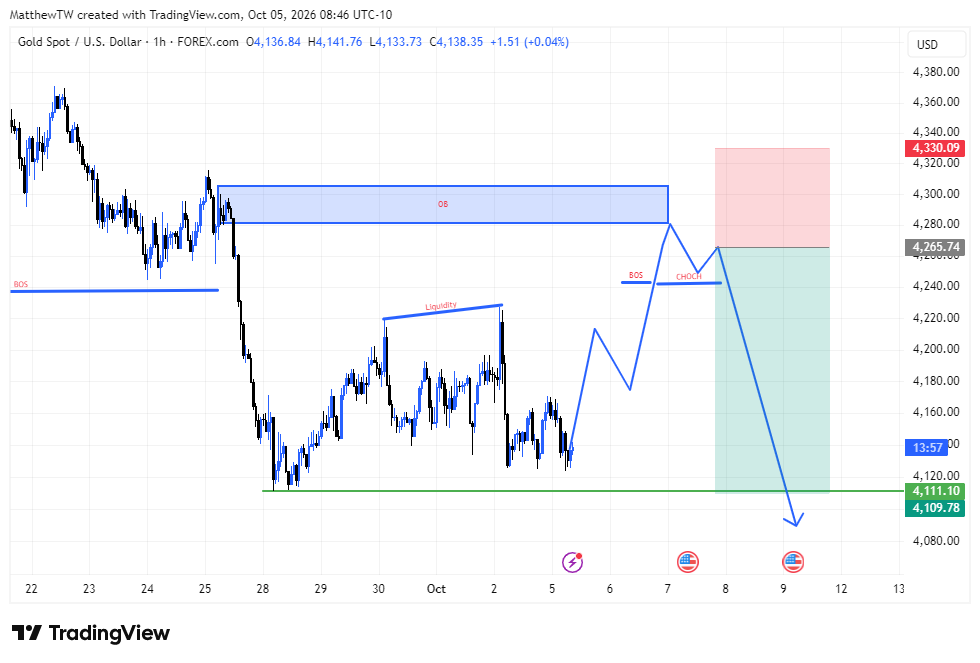
- A confirmed Break of Structure (BOS).
- Visible liquidity pools that may attract price movement.
- A valid bearish order block.
- A potential Change of Character (CHOCH) confirmation area.
The preferred approach is to wait for price to retrace back into the bearish order block and mitigate the zone. Once price reaches this area, traders should monitor lower-timeframe structure for a CHOCH confirmation before considering short positions.
At present, all major SMC components are visible on the 1-hour chart, and the market appears to be preparing for a potential retest of the identified point of interest. Until that occurs, patience remains essential.
Conclusion
Gold enters the new trading week under strong bearish pressure as rising Treasury yields, a resilient U.S. dollar, and ongoing Federal Reserve uncertainty continue to shape market sentiment.
From an SMC perspective, the technical structure remains bearish, with a clear BOS, identifiable liquidity targets, and a valid bearish order block. Traders should remain focused on waiting for price to return to key areas of interest before seeking confirmation for potential entries.
As always, disciplined risk management and patience remain critical when trading highly volatile markets such as gold.