

Introduction
Liquidity is one of the most important concepts in Smart Money Concepts (SMC) trading, yet it is often misunderstood by beginner traders. Many retail traders focus only on indicators, candlestick patterns, or support and resistance levels without understanding what truly drives the market. In reality, large financial institutions, banks, hedge funds, and other market makers move the market, and they constantly seek liquidity to execute their large orders efficiently.
If you want to improve your win rate and trade the market like institutional traders, learning how to identify and use liquidity is essential. Liquidity is often the missing piece that helps traders understand why price sweeps highs and lows before moving in its intended direction.
In this guide, you will learn the definition of liquidity, the different types of liquidity, how to identify liquidity in a trend, and how to use liquidity effectively as an SMC trader to increase your trading success.
What Is Liquidity in Forex Trading?
Liquidity refers to areas in the market where a large concentration of buy orders or sell orders has been placed. These are locations where retail traders typically place their stop-losses, pending orders, or market orders.
Because institutional traders and banks often trade with significantly larger volumes than retail traders, they require sufficient liquidity to execute their positions efficiently. As a result, they frequently target these areas of clustered orders before making a significant move.
In simple terms, liquidity is the fuel that drives market movement.
Why Liquidity Matters
Think of liquidity as a pool of orders waiting to be filled. Institutions cannot simply enter massive positions anywhere in the market because doing so could cause excessive price movement and poor execution.
Instead, they seek areas where many orders already exist. Once price reaches these liquidity zones, institutions can execute their large positions more effectively.
This understanding gives Smart Money traders a significant advantage. Rather than chasing price, SMC traders wait for price to seek liquidity before entering trades.
One of the best ways to become consistently profitable is by mastering the ability to identify where liquidity exists within a market structure.
Why Smart Money Targets Liquidity
Many retail traders believe the market moves randomly. However, Smart Money traders understand that price often moves with a purpose.
When an institution wants to sell a large position, it requires buyers on the opposite side of the trade. Likewise, when it wants to buy heavily, it needs sellers.
Liquidity provides those counterparties.
This is why you often see:
- Price taking out previous highs before falling.
- Price sweeping previous lows before rallying.
- Equal highs being broken before a bearish move.
- Equal lows being broken before a bullish move.
- Trendline breaks that quickly reverse.
These movements are often liquidity grabs designed to collect pending orders and stop-losses before the market continues in its true direction.
Understanding this principle can help traders avoid becoming part of the liquidity pool that institutional traders target.
Types of Liquidity in Smart Money Concepts
1. External Liquidity
External liquidity refers to liquidity that exists outside the current market structure.
These areas usually contain a large concentration of stop-loss orders and pending orders from retail traders.
Examples of external liquidity include:
Previous Highs
When price creates a swing high, many traders place stop-losses above that level. Institutions often target these stops before reversing price.
Previous Lows
Just as highs contain buy-side liquidity, lows often contain sell-side liquidity.
Many traders place their stops below swing lows, making them attractive targets for Smart Money.
Equal Highs
Equal highs occur when price forms two or more highs at nearly the same level.
Retail traders often assume this level represents resistance and place sell orders there while placing stop-losses above it.
This creates a liquidity pool that institutions can target.
Equal Lows
Equal lows work in the opposite way.
Retail traders see these levels as support and place buy orders around them while hiding stop-losses below.
These stops become a source of liquidity.
Order Blocks
Order blocks that remain unmitigated often attract price because they contain institutional order flow and liquidity.
These areas frequently become important reaction zones in the market.
2. Internal Liquidity
Internal liquidity exists within a market structure rather than outside it.
This type of liquidity forms during consolidations, ranging markets, and corrective moves.
Examples include:
Ranging Markets
When price moves sideways, many orders accumulate within the range.
These areas become attractive liquidity zones.
Equal Highs and Equal Lows Within a Range
A range often creates multiple equal highs and lows, generating liquidity on both sides of the market.
Trendlines
Many retail traders rely heavily on trendlines.
As a result, stop-losses often accumulate above or below trendline structures.
Institutions frequently exploit these areas before moving price in the intended direction.
Candle Wicks
Long candle wicks often indicate areas where liquidity has been collected.
These wicks can reveal where institutions have already entered the market.
How to Identify Liquidity in a Trend
One of the easiest ways to identify liquidity is by analyzing market structure.
The process begins with finding an impulsive move that creates a Break of Structure (BOS).
Step 1: Identify the Break of Structure (BOS)
A Break of Structure occurs when price breaks a significant swing point and confirms a new market direction.
For example:
In a bullish trend, price breaks a previous high.
In a bearish trend, price breaks a previous low.
This break suggests that Smart Money may have entered the market.
Step 2: Find the Order Block, Fair Value Gap (FVG), or Breaker Block
After identifying the BOS, locate the institutional area responsible for causing the break.
These areas often include:
Order Blocks
Fair Value Gaps (FVGs)
Breaker Blocks
These zones frequently become important points of interest for future entries.
Step 3: Identify Liquidity Formed After the BOS
Once the structure is broken, observe what happens next.
If price begins creating:
Ranges
Equal highs
Equal lows
Trendline formations
Consolidation zones
These formations often represent liquidity.
The key idea is that institutions frequently allow liquidity to build before targeting it later.
Step 4: Watch for Liquidity Sweeps
A liquidity sweep occurs when price moves into a liquidity zone and triggers a large number of orders.
Examples include:
- Taking out equal highs
- Taking out equal lows
- Breaking a trendline
- Sweeping a range high
- Sweeping a range low
After the liquidity is collected, price often reverses or continues aggressively in its intended direction.
Practical Example of Liquidity in a Bearish Trend
Let’s look at this bearish trend below in this image.
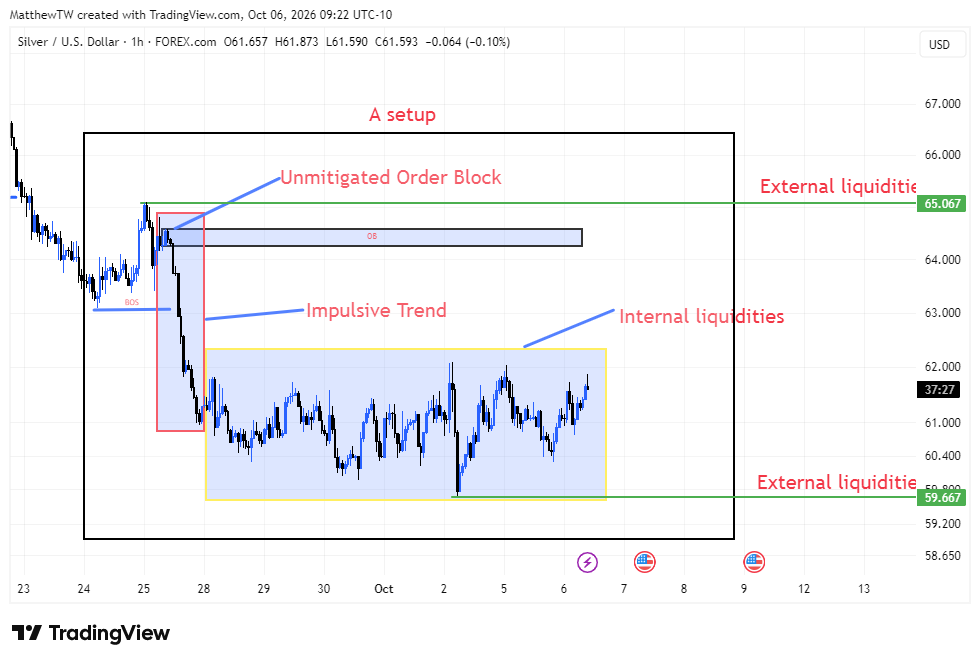
1.Price creates a significant low.
2.The low is broken, creating a bearish Break of Structure.
3.An order block forms before the BOS.
4.Price begins consolidating.
5.Equal highs start forming during the consolidation.
Most retail traders view this consolidation as a sign of strength and begin buying.
As more traders enter long positions, liquidity accumulates above the equal highs.
Eventually, price moves upward, sweeps all the equal highs, triggers the stop-losses of sellers, attracts more buyers, and collects liquidity.
Immediately after the sweep, price returns to the bearish order block and continues falling.
This is a classic Smart Money liquidity manipulation and one of the most common setups in the forex market.
How to Use Liquidity as a Smart Money Trader
Knowing where liquidity exists is valuable, but knowing how to trade it is what creates profitability.
Follow these simple steps:
1. Determine the Directional Bias
Before looking for entries, identify the overall market direction.
Ask yourself:
Is the market bullish?
Is the market bearish?
Has a major structure been broken?
Your directional bias should align with the higher timeframe structure.
Without a clear bias, liquidity analysis becomes less effective.
How to use liquidity as a smart money trade to win more trend
Firstly, you have to understand a directional bias in a trend, find a break of structure then identify and rebel the order block that cause the break to avoid confusion. then all the ranging trend after a break of structure are all liquidity.
After identifying the liquidity, wait for the price to mitigate all the liquidity before entering into any trade.
The instructional trader and bank are always looking for liquidity and once the it all mitigated the real move happen. so order block and breaker block are more safer to trade when the liquidity are build after a break of structure.
2. Wait for a Break of Structure
A Break of Structure confirms market intent.
Do not assume trend direction.
Allow the market to show its hand first.
Once the BOS occurs, begin searching for institutional footprints.
3. Mark the Order Block
Identify the order block responsible for causing the break.
This becomes your primary area of interest.
Many successful SMC traders focus heavily on order blocks because they often provide low-risk entry opportunities.
4. Identify Liquidity Zones
After the BOS, mark all obvious liquidity locations.
Examples include:
Equal highs
Equal lows
Ranges
Trendlines
Previous highs
Previous lows
These areas represent potential targets for price.
5. Wait for Liquidity to Be Mitigated
This is where many traders make mistakes.
Rather than entering immediately, wait for price to sweep or mitigate the liquidity.
Patience is critical.
The market frequently collects liquidity first before making the true move.
6. Enter from the Institutional Zone
Once the liquidity has been taken and price returns to an order block, breaker block, or Fair Value Gap, you can begin looking for entry confirmations.
By doing so, you align your trades with Smart Money rather than retail sentiment.
Common Liquidity Trading Mistakes
Many traders understand liquidity conceptually but still struggle because they make avoidable mistakes.
Trading Before Liquidity Is Taken
Entering too early often leads to stop-loss hunts.
Wait for the liquidity event first.
Ignoring Market Structure
Liquidity should never be traded in isolation.
Always combine liquidity analysis with:
- Break of Structure (BOS)
- Order Blocks
- Fair Value Gaps
- Market Structure
Chasing the Move
After liquidity is swept, traders often chase price.
Instead, wait for price to retrace into an institutional area before entering.
Trading Against the Bias
Liquidity grabs occur in both bullish and bearish markets.
Always ensure your trade aligns with the dominant trend.
Common Liquidity Trading Mistakes
Many traders understand liquidity conceptually but still struggle because they make avoidable mistakes.
Trading Before Liquidity Is Taken
Entering too early often leads to stop-loss hunts.
Wait for the liquidity event first.
Ignoring Market Structure
Liquidity should never be traded in isolation.
Always combine liquidity analysis with:
Break of Structure (BOS)
Order Blocks
Fair Value Gaps
Market Structure
Chasing the Move
After liquidity is swept, traders often chase price.
Instead, wait for price to retrace into an institutional area before entering.
Trading Against the Bias
Liquidity grabs occur in both bullish and bearish markets.
Always ensure your trade aligns with the dominant trend.
Benefits of Trading Liquidity
Using liquidity as part of your SMC strategy offers several advantages:
Higher Win Rate
Understanding liquidity helps traders enter after manipulation has occurred instead of becoming victims of it.
Better Risk-to-Reward Ratios
Trading from order blocks after liquidity sweeps often provides precise entries and tighter stop-loss placements.
Improved Market Understanding
Instead of viewing price movement as random, you begin to understand the logic behind market behavior.
Increased Patience and Discipline
Liquidity trading encourages waiting for high-probability setups rather than taking impulsive trades.
Conclusion
Liquidity is one of the most powerful concepts in Smart Money Concepts trading. It represents areas where large concentrations of orders exist and where institutional traders often seek to execute their positions.
By understanding the difference between external liquidity and internal liquidity, identifying Breaks of Structure, marking order blocks, and waiting for liquidity sweeps before entering trades, traders can significantly improve their market timing and increase their probability of success.
The key takeaway is simple: follow liquidity, don’t become liquidity.
Successful SMC traders understand that the market often seeks liquidity before making its real move. By learning to identify these areas and patiently waiting for confirmation, you can align yourself with Smart Money and develop a more profitable forex trading strategy.
Master liquidity, understand market structure, and let institutional footprints guide your trading decisions. This approach can transform the way you read the market and help you achieve greater consistency in forex trading.
[…] enter trades all at once without causing dramatic price fluctuations. Instead, they seek areas of liquidity where sufficient buy and sell orders […]